
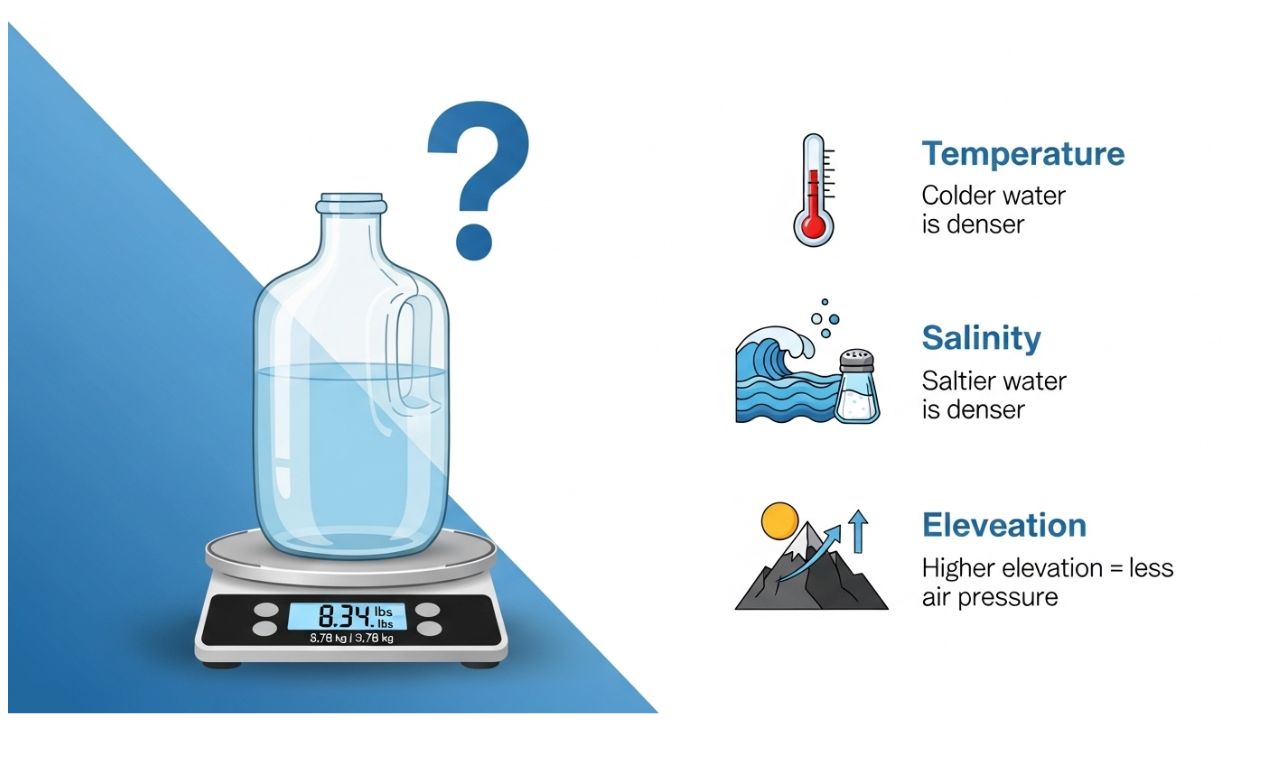
Water is one of the most essential substances on Earth, and understanding its weight is important in everyday life, cooking, science experiments, and engineering. If you’ve ever wondered, “How much does a gallon of water weigh?”, this article breaks down the answer, explores different units of measurement, and explains the factors that can influence water’s weight.
Standard Weight of a Gallon of Water
A U.S. gallon of water weighs approximately 8.34 pounds (3.78 kilograms) at room temperature (around 68°F or 20°C). This weight is based on the U.S. liquid gallon, which equals 128 U.S. fluid ounces or roughly 3.785 liters.
For those using the imperial gallon (commonly used in the UK), a gallon of water weighs about 10.02 pounds (4.54 kilograms), since the imperial gallon is larger at 160 fluid ounces or 4.546 liters.
Quick Reference: Gallon of Water Weight
| Measurement System | Volume | Weight |
|---|---|---|
| U.S. Liquid Gallon | 3.785 L | 8.34 lbs (3.78 kg) |
| Imperial Gallon | 4.546 L | 10.02 lbs (4.54 kg) |
Factors Affecting the Weight of Water
While 8.34 pounds is the standard weight for a U.S. gallon, several factors can slightly change the weight:
-
Temperature – Water expands slightly when heated and contracts when cooled. Cold water is denser, so a gallon of cold water may weigh a tiny bit more than a gallon of hot water.
-
Purity – Tap water often contains minerals and impurities that can slightly increase its weight. Distilled water is very close to the standard weight.
-
Altitude and Pressure – The effects are minimal but technically water weight can vary slightly at different altitudes due to pressure changes.
For most practical purposes, these differences are negligible.
Weight of Water in Other Common Units
Knowing the weight of water in different units can be useful in cooking, science, and logistics.
-
1 liter of water: ~2.2046 pounds (1 kg)
-
1 cup of water (U.S.): ~0.52 pounds (236 grams)
-
1 pint of water (U.S.): ~1.04 pounds (473 grams)
-
1 quart of water (U.S.): ~2.08 pounds (946 grams)
Understanding these conversions helps with recipes, scientific calculations, and moving large quantities of water.
Why Knowing Water Weight Is Important
-
Cooking and Baking – Recipes often require precise water measurements. Knowing water weight ensures accuracy for consistent results.
-
Science Experiments – Calculating mass and density often requires knowing water weight for precise measurements.
-
Fitness and Hydration – For water intake recommendations or hydration tracking, understanding volume and weight helps.
-
Logistics and Transportation – Moving water for industrial, agricultural, or household use requires knowledge of weight to prevent overloading vehicles.
Examples of Water Weight in Everyday Life
-
A 5-gallon water jug weighs about 41.7 pounds (18.9 kg).
-
A standard 55-gallon drum of water weighs approximately 458.7 pounds (208 kg).
-
Carrying 2 gallons of water for camping or emergency preparedness would weigh roughly 16.7 pounds (7.57 kg).
These practical examples help visualize how water weight adds up quickly with larger quantities.
Conclusion
A gallon of water weighs approximately 8.34 pounds (3.78 kilograms) in the U.S. system and 10.02 pounds (4.54 kilograms) in the imperial system. Temperature, purity, and altitude can cause minor variations, but for most everyday uses, the standard weight is sufficient. Understanding the weight of water is useful in cooking, science, transportation, and health-related activities, making it a handy fact for daily life.