
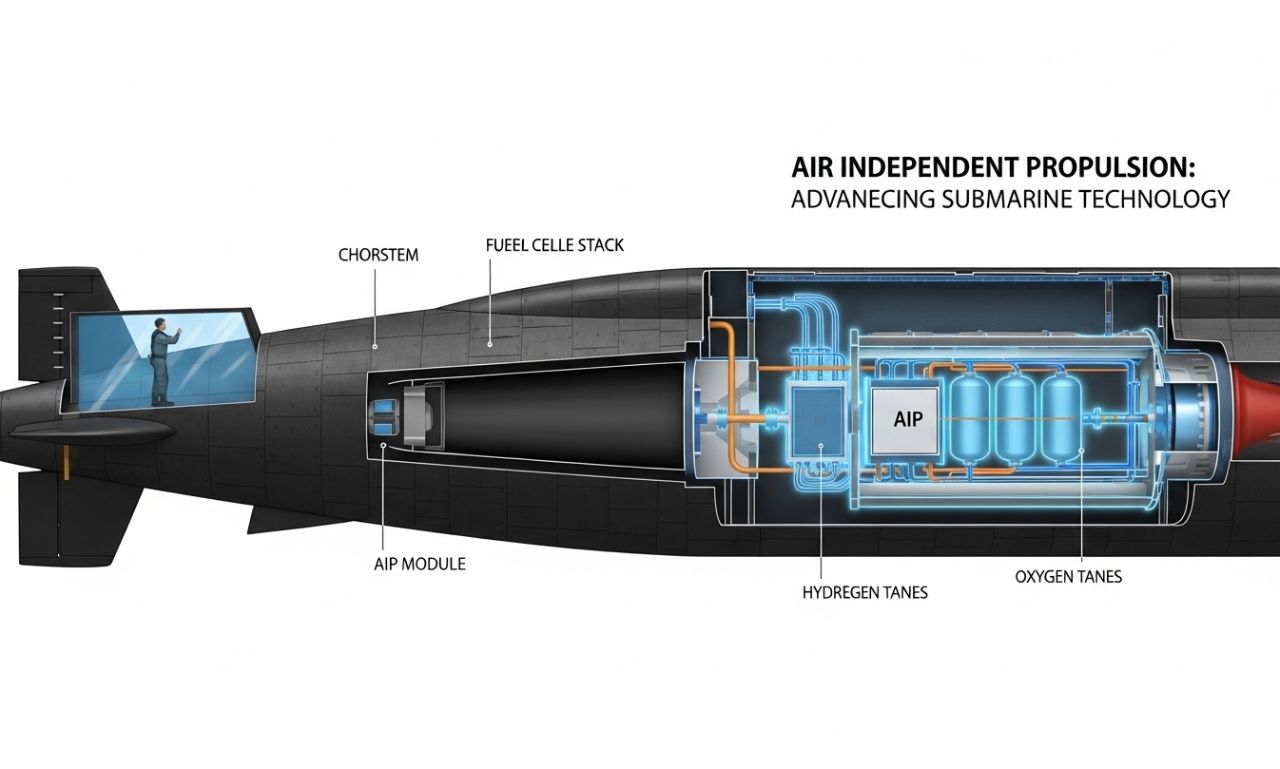
Air Independent Propulsion (AIP) is a cutting-edge technology that allows non-nuclear submarines to operate underwater for extended periods without surfacing or using a snorkel to access atmospheric oxygen. By enhancing stealth, endurance, and operational efficiency, AIP has transformed conventional submarine design and capability.
This article explores the concept of air independent propulsion, its types, applications, benefits, and impact on modern naval warfare.
What Is Air Independent Propulsion?
Traditional diesel-electric submarines rely on batteries when submerged, which limits their underwater endurance to a few days at low speeds. To recharge batteries, they must surface or use a snorkel, exposing themselves to detection.
Air Independent Propulsion (AIP) enables submarines to generate power without external oxygen sources, extending submerged endurance from days to weeks. This provides tactical advantages in stealth and operational flexibility.
AIP systems are typically used in conventional (non-nuclear) submarines, bridging the gap between diesel-electric and nuclear-powered vessels.
Types of Air Independent Propulsion
Several AIP technologies have been developed, each with unique mechanisms and advantages:
1. Stirling Engine AIP
-
Uses a closed-cycle Stirling engine fueled by liquid oxygen.
-
Converts heat energy into mechanical power to drive propellers or charge batteries.
-
Offers quiet operation, making it ideal for stealth missions.
2. Fuel Cell AIP
-
Generates electricity through chemical reactions, typically using hydrogen and oxygen.
-
Produces water as a byproduct, making it environmentally clean.
-
Provides efficient and silent propulsion for extended underwater endurance.
3. Closed-Cycle Diesel Engines
-
Modified diesel engines operate in a sealed system with stored oxygen.
-
Less common due to complexity and noise compared to Stirling or fuel cell systems.
4. Hybrid Systems
-
Combines battery power with AIP for optimal efficiency and flexibility.
-
Allows submarines to switch between AIP and conventional battery modes depending on mission requirements.
Benefits of Air Independent Propulsion
AIP offers several advantages for modern navies:
-
Extended Submerged Endurance – Submarines can remain underwater for weeks, increasing operational stealth.
-
Reduced Detection Risk – Less need to surface reduces exposure to radar, sonar, and satellite surveillance.
-
Improved Tactical Flexibility – Enables covert patrols, surveillance, and surprise attacks.
-
Lower Operational Costs – Cheaper to maintain and operate compared to nuclear submarines.
-
Environmental Efficiency – Fuel cells, in particular, produce minimal emissions.
These benefits make AIP-equipped submarines highly valuable in modern naval strategy.
Applications of AIP Technology
Air independent propulsion is widely used in conventional submarines for both military and strategic purposes:
-
Coastal Defense – Patrolling territorial waters quietly and efficiently.
-
Surveillance Missions – Monitoring enemy movements without detection.
-
Special Operations – Transporting special forces covertly.
-
Export and Commercial Use – Many countries adopt AIP in non-nuclear submarines for cost-effective naval modernization.
Several countries, including Germany, Sweden, Japan, and South Korea, have successfully deployed AIP-equipped submarines.
Challenges of AIP
While AIP provides substantial benefits, there are challenges:
-
Limited Speed – AIP systems usually provide low to moderate speed, suitable for stealth but not rapid transit.
-
Storage Constraints – Oxygen or hydrogen storage limits the duration of underwater operations.
-
Complexity and Maintenance – Advanced AIP systems require specialized maintenance and crew training.
-
Integration Costs – Adding AIP to existing submarine designs can be expensive.
Despite these challenges, AIP technology continues to evolve and improve with research and innovation.
Future of Air Independent Propulsion
The future of AIP includes:
-
Improved Fuel Cells – Higher efficiency, longer endurance, and safer operation.
-
Hybrid Submarines – Combining battery, AIP, and advanced energy storage for optimal performance.
-
Enhanced Stealth – Quieter propulsion systems to evade increasingly sophisticated detection technologies.
-
Global Adoption – More navies investing in AIP submarines as cost-effective alternatives to nuclear propulsion.
As navies seek quieter, more covert, and longer-endurance submarines, AIP will remain a key technology in naval warfare.
Conclusion
Air Independent Propulsion has revolutionized conventional submarine operations, offering extended underwater endurance, enhanced stealth, and tactical flexibility. By combining innovative power systems such as Stirling engines and fuel cells, AIP bridges the gap between diesel-electric and nuclear-powered submarines. Despite limitations, ongoing advancements promise a future where non-nuclear submarines are quieter, more capable, and strategically valuable in modern naval operations.