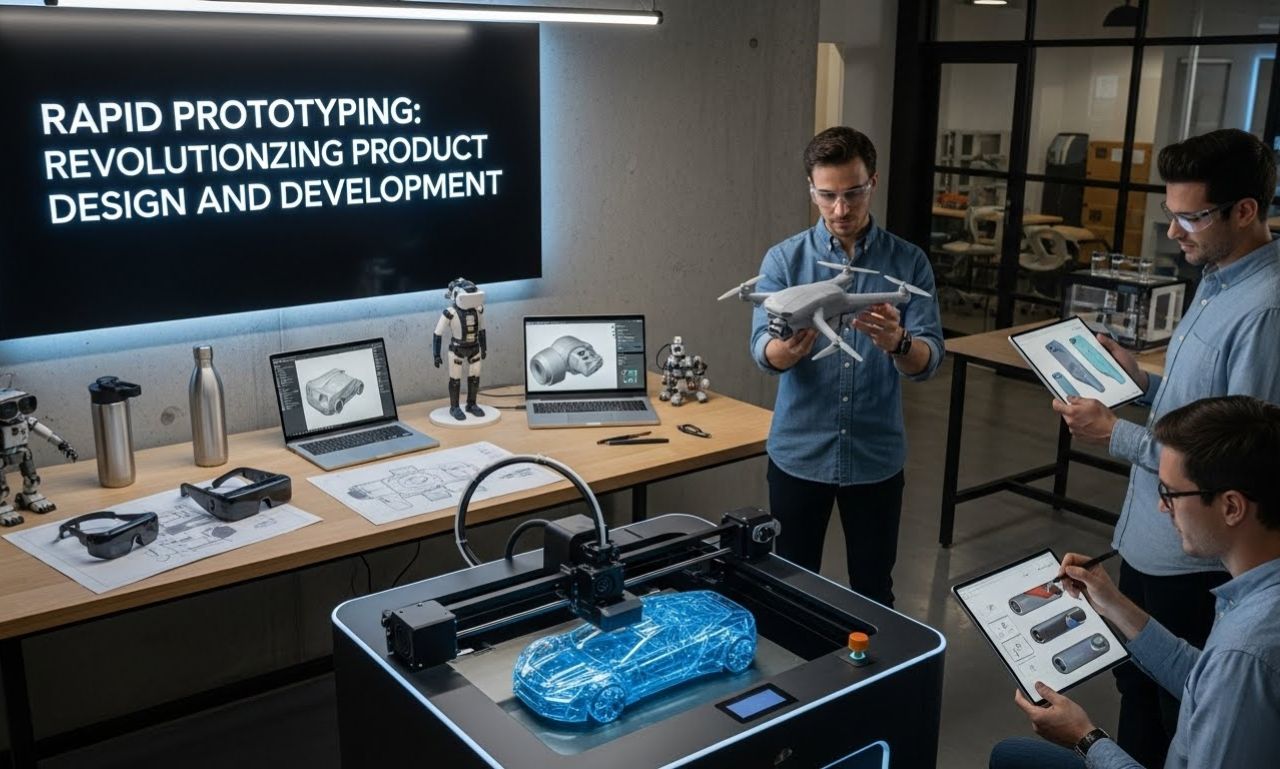
In today’s fast-paced world of innovation, speed and accuracy are essential in product development. Rapid prototyping is a technology-driven process that allows designers, engineers, and manufacturers to quickly transform concepts into physical or digital models. By creating prototypes early in the development process, teams can identify flaws, improve design, and accelerate time-to-market.
Rapid prototyping is widely used across industries such as automotive, aerospace, medical devices, consumer electronics, and architecture. This article explores its methods, benefits, applications, challenges, and future trends.
What Is Rapid Prototyping?
Rapid prototyping (RP) is a set of techniques that quickly create scale models or functional prototypes of products using computer-aided design (CAD) data. Unlike traditional manufacturing, which can take weeks or months to produce prototypes, RP emphasizes speed, accuracy, and flexibility.
The main purpose of rapid prototyping is to test, validate, and improve designs before mass production, ensuring higher quality and reducing production costs.
Key Methods of Rapid Prototyping
1. 3D Printing (Additive Manufacturing)
3D printing is the most common RP technique. It builds objects layer by layer using materials such as plastic, resin, or metal. 3D printing allows complex designs that would be impossible with traditional methods.
2. Stereolithography (SLA)
SLA uses ultraviolet lasers to harden liquid resin into precise 3D shapes. It is known for high accuracy and smooth surface finishes, often used in medical models and high-detail engineering components.
3. Fused Deposition Modeling (FDM)
FDM melts and extrudes thermoplastic filaments layer by layer. This method is cost-effective and widely used for proof-of-concept prototypes and early-stage testing.
4. Selective Laser Sintering (SLS)
SLS uses lasers to fuse powdered materials into solid structures. It is ideal for functional prototypes that require mechanical strength and durability.
5. CNC Machining
CNC machining is a subtractive method where material is removed from a solid block to create the prototype. It provides high precision and is suitable for metal and durable prototypes.
Benefits of Rapid Prototyping
1. Speeds Up Product Development
RP allows faster testing and iteration, significantly reducing the time from concept to production.
2. Reduces Costs
By detecting design flaws early, RP minimizes expensive errors during manufacturing. It also reduces material waste compared to traditional trial-and-error methods.
3. Improves Design Accuracy
Physical prototypes help teams verify dimensions, ergonomics, and functionality before final production.
4. Enhances Communication
Prototypes act as tangible models for stakeholders, facilitating better feedback and collaboration.
5. Encourages Innovation
Rapid iteration enables experimentation with multiple design concepts, fostering creativity and innovation.
Applications of Rapid Prototyping
1. Automotive Industry
Automakers use RP to design engines, body panels, and interiors, allowing for testing of aerodynamics and ergonomics before production.
2. Aerospace
Aerospace engineers create lightweight, high-strength components and test aerodynamic efficiency using RP, reducing development risks.
3. Medical Devices
From prosthetics to surgical tools, RP helps produce patient-specific models with high precision.
4. Consumer Electronics
RP is used to test designs of smartphones, wearable devices, and gadgets to ensure usability and functionality.
5. Architecture
Architects use RP to build scale models of buildings and infrastructure projects, helping visualize designs and identify structural issues early.
Challenges in Rapid Prototyping
1. Material Limitations
Prototypes may not always replicate the final material’s mechanical properties, affecting functional testing.
2. Equipment Costs
Advanced RP equipment, like SLA and SLS machines, can be expensive and may be out of reach for small businesses.
3. Post-Processing Requirements
Some prototypes require additional finishing to improve surface quality or functionality, increasing time and cost.
4. Design Constraints
Certain RP methods may limit shape, size, or material selection, requiring careful planning during the design phase.
Best Practices for Effective Rapid Prototyping
-
Start with detailed CAD models for accurate and efficient prototypes.
-
Select the appropriate RP method based on material, cost, and functional needs.
-
Iterate frequently to refine designs quickly.
-
Gather stakeholder feedback early to reduce errors and improve satisfaction.
-
Consider material properties to ensure realistic performance in testing.
Future Trends in Rapid Prototyping
-
Advanced Materials: Biocompatible resins, composite powders, and conductive materials expand RP applications.
-
Integration with AI: Artificial intelligence can optimize designs and predict failures before physical production.
-
Sustainable RP: Eco-friendly and recyclable materials reduce environmental impact.
-
Faster and More Precise Machines: Next-generation RP technology offers higher accuracy and speed, reducing iteration time.
Conclusion
Rapid prototyping is revolutionizing product development by enabling faster, cost-effective, and precise testing of designs. Its applications across industries like automotive, aerospace, medical devices, and consumer electronics demonstrate its versatility and value. By embracing RP, companies can innovate faster, reduce production costs, and bring high-quality products to market more efficiently.
Rapid prototyping not only improves design accuracy and functionality but also fosters creativity, ensuring that the final products meet both consumer expectations and industry standards.