
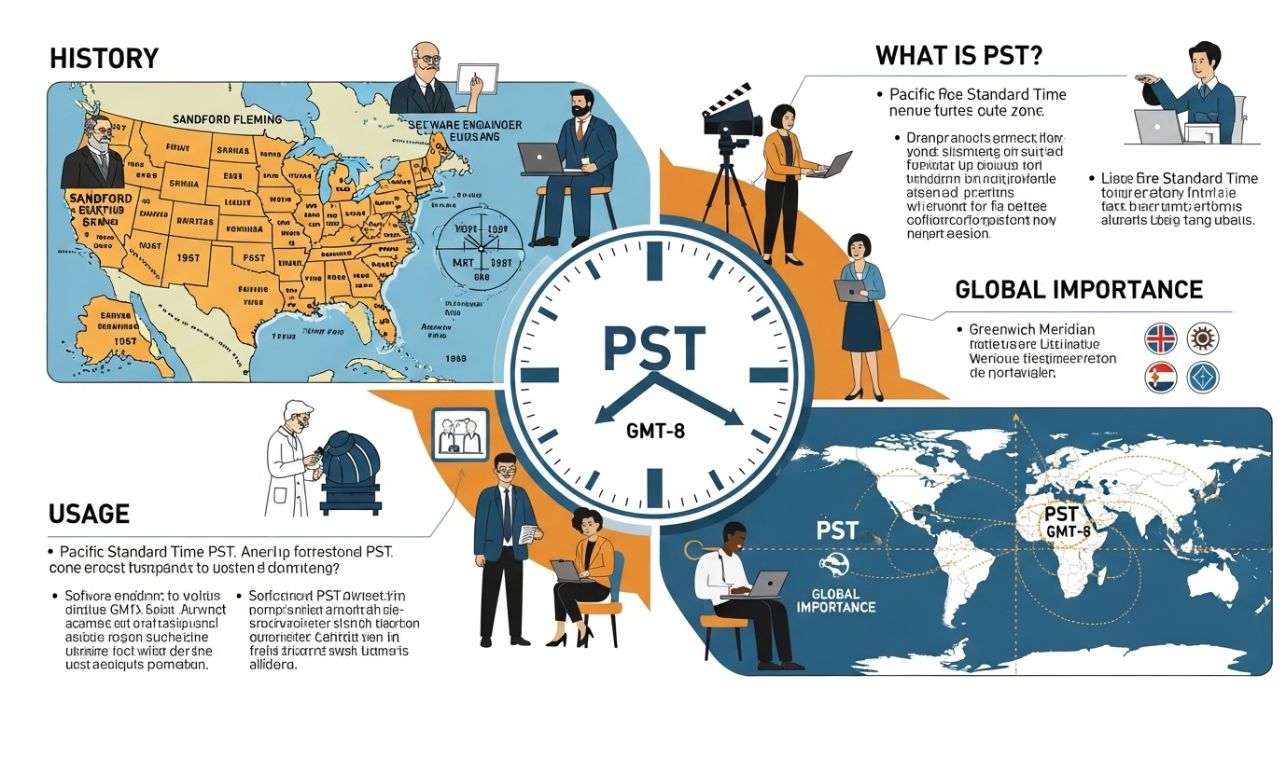
Pacific Standard Time (PST) is a time zone used in the western United States, Canada, and parts of Mexico. It is eight hours behind Coordinated Universal Time (UTC−8). The concept of Pacific Standard Time helps synchronize daily life, business operations, and travel schedules across multiple regions. Understanding PST is essential for communication, commerce, and global interactions, particularly when coordinating with other time zones. Whether you live in California, British Columbia, or Baja California, knowing Pacific Standard Time ensures you remain aligned with local and international activities.
History and Origin of Pacific Standard Time
The Creation of Standard Time Zones
Before standardized time, towns and cities used local mean time, which varied by longitude. The expansion of railroads in the 19th century highlighted the need for consistent timekeeping. In 1883, North American railroads established time zones, including the Pacific Time Zone, which would later define Pacific Standard Time as a uniform standard across the western coast.
Adoption by Law
Pacific Standard Time was formally codified with the Standard Time Act of 1918 in the United States. The law established the Pacific Time Zone as one of several official zones and set rules for observance of daylight saving time. Canada and Mexico adopted similar standards to ensure cross-border alignment with trade and communication.
Where Pacific Standard Time Is Used
United States
In the U.S., Pac ific Stand ard Ti me covers states including:
-
California
-
Washington
-
Oregon
-
Nevada
Parts of Idaho, Montana, and other western states occasionally observe PST in specific regions.
Canada
In Canada, PST is observed in:
-
British Columbia
-
Yukon Territory (some areas switch seasonally)
Mexico
In Mexico, P acific Sta ndard Ti me applies to states such as Baja California, aligning closely with the U.S. west coast.
Pacific Standard Time vs. Pacific Daylight Time
Understanding the Difference
Pac ific Stand ard T ime (PST) is observed during the fall and winter months. In contrast, Pacific Daylight Time (PDT) is observed in spring and summer when clocks are advanced by one hour to UTC−7. This adjustment, part of daylight saving time, allows for longer evening daylight, benefiting energy use and outdoor activities.
When to Switch Between PST and PDT
-
PST: Early November to mid-March
-
PDT: Mid-March to early November
Switching can affect international meetings, airline schedules, and broadcast programming, making awareness of PST versus PDT crucial for scheduling.
Global Relevance of Pacific Standard Time
International Business and Communication
Pacif ic Stan dard Tim e plays a vital role in global business. Major technology companies in Silicon Valley operate in PST, influencing stock markets, remote collaborations, and client meetings worldwide. Knowing PST helps coordinate virtual conferences, trade hours, and supply chain operations across continents.
Travel and Scheduling
For travelers, understanding Pacific Standard Time ensures accurate flight schedules, hotel check-ins, and event planning. Whether flying from Asia, Europe, or the eastern U.S., travelers must account for the time difference to avoid missed connections.
How Pacific Standard Time Impacts Daily Life
Work and Productivity
In regions observing PST, workdays, school schedules, and television programming are all based on local time. Businesses must coordinate with partners in different time zones, requiring awareness of PST to avoid scheduling conflicts.
Digital Devices and Technology
Modern devices automatically adjust for Paci fic Stand ard T ime based on location. Smartphones, computers, and smart home systems detect PST settings to provide correct local time, alarms, and reminders. Cloud services and applications often use PST as a reference for scheduling events in North America.
Interesting Facts About Pacific Standard Time
-
UTC Offset: PST is always UTC−8, making it one of the eight-hour offsets from Coordinated Universal Time.
-
Major Cities: Los Angeles, San Francisco, Seattle, and Vancouver operate in PST during standard time.
-
Impact on Media: Television shows and live broadcasts in the U.S. are often scheduled according to PST or PDT.
-
Weather and Daylight: The observance of PST affects sunrise and sunset times, which can influence energy use and lifestyle habits.
-
Tech Industry Hub: Silicon Valley companies, including Apple, Google, and Facebook, operate primarily in PST.
How to Convert Pacific Standard Time
To Eastern Standard Time
Add three hours to PST to get EST. For example, 9:00 AM PST equals 12:00 PM EST.
To Greenwich Mean Time (GMT)
Add eight hours to PST. For example, 9:00 AM PST equals 5:00 PM GMT.
To Other International Zones
Online tools and smartphone apps make it simple to convert PST to almost any time zone, essential for travelers and global businesses.
Challenges with Pacific Standard Time
Daylight Saving Confusion
Switching between PST and PDT can lead to scheduling errors if international partners or travel plans are not updated. Miscommunication often occurs during the transition weeks.
Technology Limitations
While most devices auto-adjust for PST and PDT, older systems or misconfigured software can cause inaccurate time displays, leading to missed appointments or deadlines.
Global Coordination
Coordinating meetings across multiple continents can be complex, particularly during overlapping daylight saving time changes, requiring careful attention to PST conversion.
Conclusion:
Pa cific Standa rd Time is more than just a regional time zone; it serves as a critical anchor for daily life, commerce, travel, and digital communications in western North America. Understanding PST, its differences from Pacific Daylight Time, and its global relevance is essential for anyone coordinating work, meetings, or travel across time zones. From the bustling tech hubs of California to international business calls, PST ensures synchronization, efficiency, and effective scheduling.
By staying informed about Pacif ic Stan dard T ime, individuals and businesses can navigate time-sensitive activities, maintain productivity, and engage successfully in a globally connected world.