
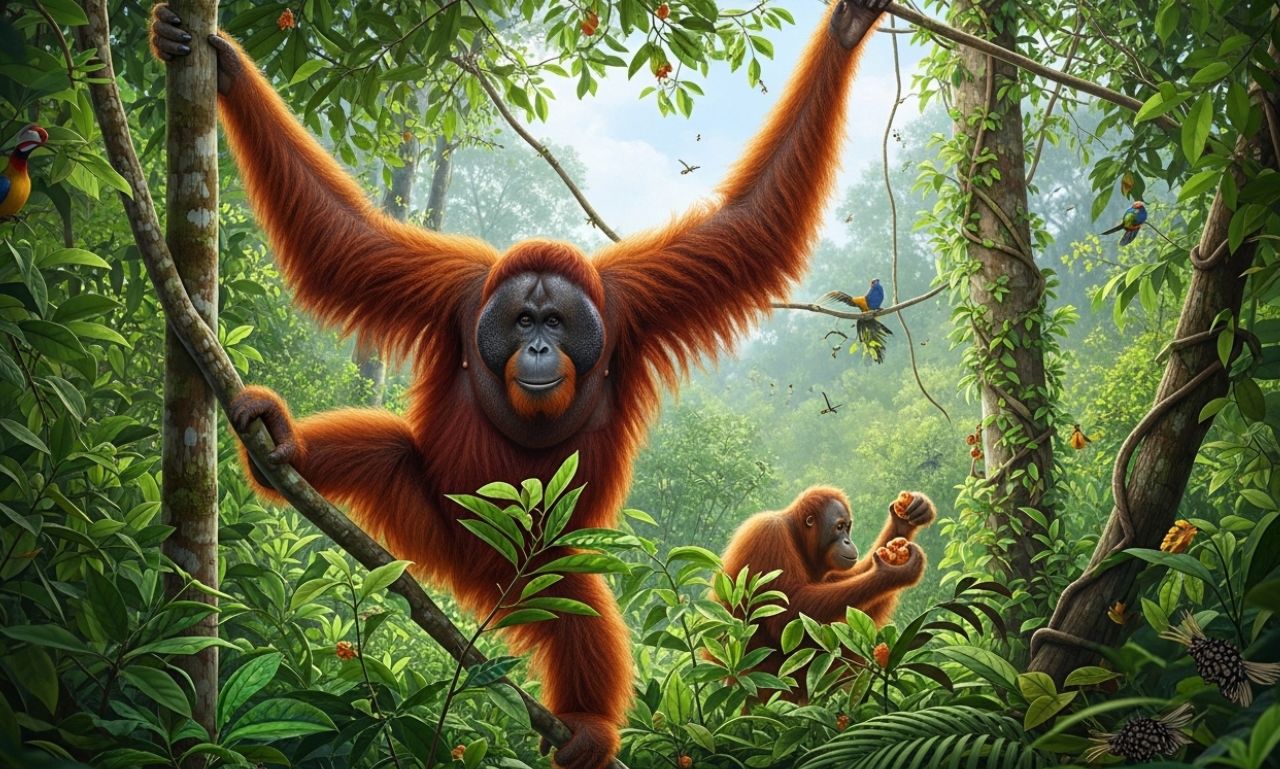
Orangutans are great apes native to the rainforests of Borneo and Sumatra. Known for their distinctive reddish-brown hair and high intelligence, orangutans are among the closest relatives of humans.
The word “orangutan” comes from the Malay language, meaning “person of the forest”. These apes are remarkable for their problem-solving skills, use of tools, and complex social behaviors. Unfortunately, orangutans face significant threats from deforestation, poaching, and habitat loss, making conservation efforts critical for their survival.
Species of Orangutans
There are three recognized species of orangutans:
-
Bornean Orangutan (Pongo pygmaeus)
-
Found on the island of Borneo
-
Largest population but declining due to logging and palm oil plantations
-
-
Sumatran Orangutan (Pongo abelii)
-
Found on the island of Sumatra
-
Critically endangered, with fewer than 14,000 individuals remaining
-
-
Tapanuli Orangutan (Pongo tapanuliensis)
-
Discovered in 2017 on Sumatra
-
The rarest species, with fewer than 800 individuals
-
Each species has unique characteristics and faces different conservation challenges.
Physical Characteristics
Size and Appearance
Orangutans are the largest arboreal mammals, with long, powerful arms adapted for swinging between trees. Adult males can weigh up to 90 kg (200 lbs), while females are smaller, around 45–50 kg (100–110 lbs).
Distinctive features include:
-
Long, reddish-brown hair
-
Large cheek pads in mature males (called flanges)
-
Prehensile hands and feet for gripping branches
Lifespan
In the wild, orangutans can live 30–40 years, while in captivity, they may live up to 50 years due to better healthcare and nutrition.
Habitat and Range
Orangutans primarily live in tropical rainforests, including lowland, swamp, and mountainous forests. They are arboreal, spending most of their time in trees, where they build nests to sleep each night.
Deforestation for agriculture, logging, and palm oil plantations has significantly reduced their habitat, forcing many orangutans into fragmented forests and increasing human-wildlife conflicts.
Behavior and Social Structure
Solitary Lifestyle
Unlike other great apes, orangutans are mostly solitary. Adult males maintain territories, while females live with their dependent offspring. Social interactions occur primarily during mating or occasional feeding gatherings.
Diet
Orangutans are omnivorous, with a diet mainly consisting of:
-
Fruits (especially durians, figs, and mangos)
-
Leaves and bark
-
Insects and occasionally bird eggs
Their diet changes seasonally based on food availability, demonstrating high adaptability and intelligence in foraging.
Tool Use
Orangutans are known for using tools, such as sticks to extract insects from tree bark or leaves as makeshift umbrellas. This behavior indicates advanced problem-solving skills and cognitive abilities similar to humans.
Reproduction and Lifespan
Female orangutans typically give birth once every 7–9 years, one of the slowest reproductive rates among mammals. A single infant stays with its mother for 6–8 years, learning essential survival and social skills.
This slow reproduction rate, combined with habitat loss, makes orangutan populations especially vulnerable to decline.
Conservation Status
Threats
Orangutans are critically endangered due to:
-
Deforestation: Logging and palm oil plantations destroy their habitats.
-
Poaching: Capturing infants for the illegal pet trade often results in the death of adult females.
-
Human-Wildlife Conflict: Orangutans may raid crops, leading to retaliation by farmers.
Conservation Efforts
Conservation organizations and governments are working to protect orangutans through:
-
Protected areas and national parks in Borneo and Sumatra
-
Rehabilitation centers for rescued or orphaned orangutans
-
Public awareness campaigns and responsible palm oil initiatives
-
Anti-poaching laws and enforcement
Organizations such as the World Wildlife Fund (WWF), Orangutan Foundation International (OFI), and Borneo Orangutan Survival Foundation (BOS) are actively involved in conservation.
Orangutans and Human Culture
Orangutans hold symbolic significance in Southeast Asia, representing wisdom, gentleness, and the forest itself. They appear in local folklore, educational programs, and wildlife tourism, which also helps raise funds for their conservation.
Interesting Facts About Orangutans
-
Orangutans share 97% of their DNA with humans.
-
They are highly intelligent, capable of learning sign language and solving puzzles.
-
Orangutans build sleeping nests in trees every night.
-
Male orangutans use long calls to communicate across distances.
-
Habitat fragmentation has forced some orangutans to adapt to human environments, searching for food near villages.
Conclusion
Orangutans are extraordinary creatures, combining intelligence, adaptability, and complex behaviors that make them one of the most fascinating primates. However, they face grave threats from habitat destruction, poaching, and human expansion.
Conservation efforts are critical to ensuring that these “people of the forest” continue to thrive in their natural habitats. By supporting conservation initiatives and raising awareness, humans can help protect orangutans and preserve one of the world’s most remarkable species.