
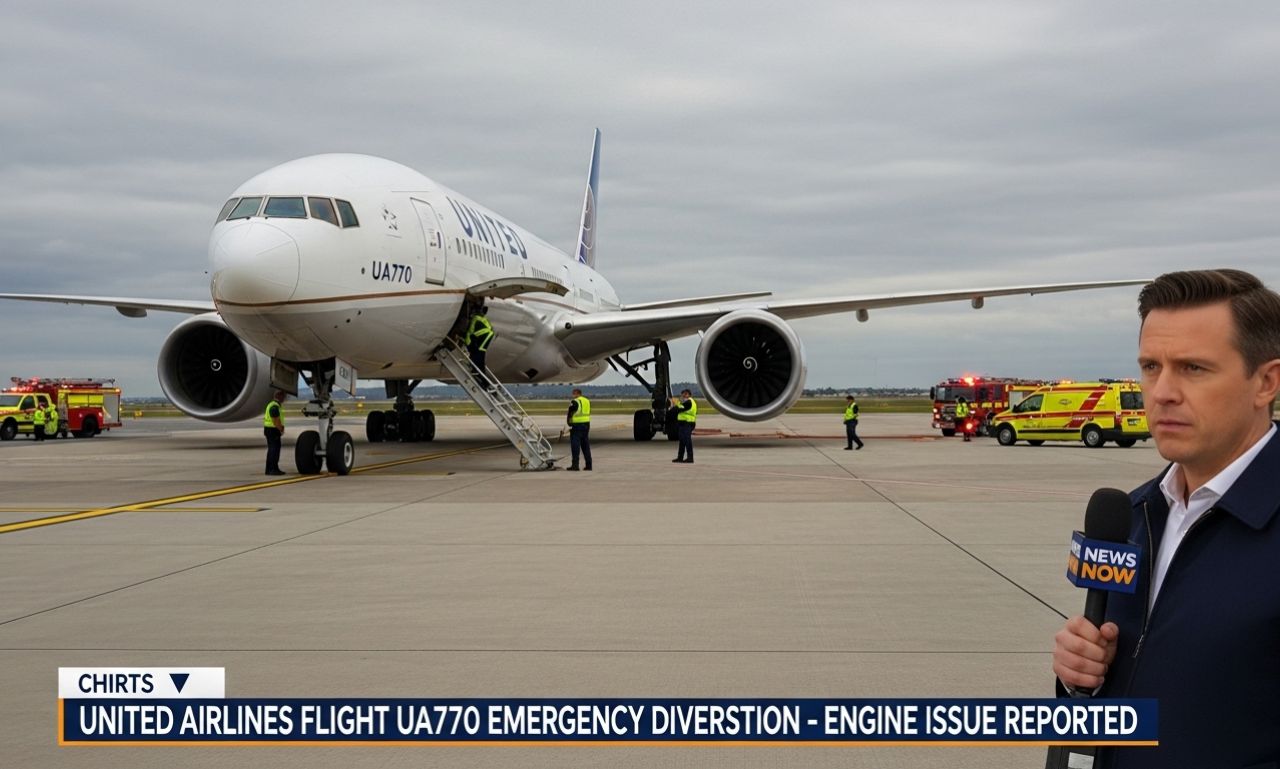
United Airlines flight UA770 faced an emergency diversion mid-air, drawing global attention and reminding the world of how aviation safety systems work under pressure. The transatlantic flight, scheduled from Barcelona, Spain to Chicago’s O’Hare International Airport, declared an emergency and diverted to London Heathrow Airport before completing its journey. This article explores what unfolded, why the diversion occurred, how the situation was handled, and what this means for passengers and airline operations.
What Was United Airlines Flight UA770?
United Airlines Flight UA770 was a scheduled long-haul service connecting Barcelona–El Prat Airport (BCN) in Spain with Chicago O’Hare International Airport (ORD) in the United States. Operated with a Boeing 787-9 Dreamliner, this flight typically carries hundreds of passengers and crew across the Atlantic on a routine schedule.
On the date of the incident, what began as a standard international flight quickly shifted into an aviation emergency when the flight crew made a critical decision mid-air.
Emergency Declaration and the Diversion Decision United Airlines Flight UA770
Midway across European airspace, Flight UA770’s cockpit crew encountered a situation serious enough that they declared an emergency. In aviation, pilots use the international transponder code 7700 to alert air traffic control (ATC) that they are facing an unspecified, critical situation requiring immediate priority handling and clearance.
Once the emergency was declared, the aircraft was rerouted to London Heathrow Airport (LHR) — a major international hub with extensive emergency-handling facilities. The flight then landed safely on one of Heathrow’s runways under controlled conditions.
Diversions like this are always pre-planned in ATC systems: major airports such as London Heathrow serve as widely recognized alternates for transatlantic flights, especially when safety concerns arise.
Why Do Flights Like UA770 Declare Emergencies?
At this point, specific official details about the exact cause of the UA770 diversion remain limited, and the airline has provided few specifics beyond confirming the safe diversion. However, flight diversions can occur for several reasons:
Possible Causes of In-Flight Diversions
-
Technical or mechanical warnings — systems aboard aircraft can detect issues requiring immediate attention.
-
Environmental or atmospheric conditions — turbulence or weather-related factors sometimes make continuation unsafe.
-
Medical emergencies onboard — crew may divert if a passenger’s health requires urgent care.
-
Operational or safety alerts from aircraft systems — such as pressurisation, engine, or sensor warnings.
Emergency diversions, though uncommon, are part of aviation safety planning. They are designed to prioritize passenger welfare and allow pilots to land at the nearest suitable airport when required.
The Diversion to London Heathrow
Upon declaring the emergency, the flight crew, in communication with ATC, selected London Heathrow Airport as the most appropriate alternate. Heathrow is frequently used as a diversion point for transatlantic flights between Europe and North America, thanks to its infrastructure and capacity to handle large aircraft in emergency conditions.
Once on the ground, passengers and crew were safely disembarked. Local airport and airline teams stood ready with emergency support personnel as a precaution.
Passenger Experience and Airline Response
Passengers aboard Flight UA770 understandably faced uncertainty and concern, but all reports confirm that everyone landed safely with no serious injuries reported. Following standard procedure after an emergency diversion:
-
Flight attendants and ground staff ensured orderly disembarkation.
-
United Airlines provided standard support, which may include meal vouchers, re-booking options, and accommodations as needed.
-
Airlines typically dispatch replacement aircraft once the situation is resolved and cleared.
United Airlines has emphasised that safety remains its top priority, and this incident reinforces the importance of rigorous protocols and pilot training in handling unplanned events.
Aviation Safety: How Diversions Fit In
Diversions such as the one involving United Airlines Flight UA770 are extremely rare relative to the total number of flights that operate every day worldwide. However, they demonstrate several core principles of modern aviation:
Robust Emergency Protocols United Airlines Flight UA770
Airlines train their crews extensively in emergency communication, procedural actions, and decision-making under pressure. Pilots practice simulator scenarios for a wide range of situations, including system malfunctions and medical needs.
Air Traffic Control Coordination
Global aviation relies on real-time coordination between pilots, onboard systems, and ATC to alter flights safely when needed. Priority handling and clearances ensure aircraft can reach alternate airports with minimal delay.
Passenger Safety First
From the moment an abnormal condition is detected, airline operations aim to prioritise passenger and crew safety above schedules or convenience. This can result in diversion decisions that appear abrupt, but are ultimately about risk management.
What Happens After a Diversion United Airlines Flight UA770
After the plane lands and passengers disembark:
-
Aircraft is examined by technical teams to diagnose the cause and determine airworthiness.
-
Airline operations may assign a different aircraft to continue the original route.
-
Passengers are assisted with onward travel logistics.
Diversions generally have minimal long-term impact on airline schedules, though individual itineraries can be disrupted temporarily.
Broader Perspective: Diversions Are Safety Successes
While lay observers might view an in-air diversion as alarming, they are widely considered a success of aviation safety — showing that systems in place can detect, respond to, and resolve unexpected situations without harm. In the case of Flight UA770, the controlled diversion and safe landing underscore this fact.
Rather than a failure, an emergency diversion reflects an aircraft crew’s ability to prioritise safety and take decisive action when circumstances demand it.